
BD Production Site, Plymouth. UK. 7th September 2026
Tony Cambridge – Independent Consultant, Diagnostics
I recently had the pleasure of visiting the Becton Dickinson Plymouth production site, the main site for production of products in the Vacutainer® portfolio.
On collecting my visitor badge, I was met by Simon Jones, Senior Director who led me to a meeting room to be introduced to individuals from the senior management team, Jason Richards (Associate Director of Operations) and Max Leach (Senior Operations Manager). I was accompanied on the tour by Megan Thomas, Medical Affairs Manager.
The meet and greet served as an ice breaker, Simon Jones delivering a short presentation about the history and activities of the company, sharing facts and figures that illustrated the complex nature of the business, the targets already met and those aspired to, as well as how Becton Dickinson demonstrate their commitment to social values. It was clear that the company is integrated with the community, as well as a significant contributor to the local economy. The site produces 2.7 billion blood collection tubes, syringes and needle systems per annum.

Becton Dickinson production site in Plymouth
I learned that the site has been manufacturing since 1981, operates a 24 hour a day, 7 days a week model and employs approximately 800 associates across all roles. Activities are delivered across two main buildings, resembling large hangars with a large estate (a total of 27 acres) for future expansion. A recent addition to the site has been the provision of a base for the South West Blood Bikes charity, which supports the region’s healthcare system by collecting and delivering patient samples for NHS partners.
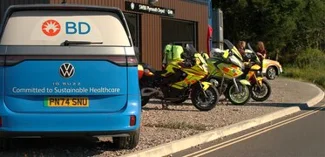
South West Blood Bikes Charity base
The healthcare system is heavily reliant on products which support clinical laboratory and decentralised testing such as point of care services. The sheer volume of tests required on a daily basis across the NHS and private healthcare demands continuous supply of high quality, robust products. Each shipped product represents a patient experience, as well as the experience of the care provider, with appropriate clinical decisions starting with the availability, quality and reliability of the products used in the testing pathway.
Building One
My tour began in Building One, hosted by Jason Richards. I was provided with safety shoes and the relevant personal protective equipment (PPE) such as safety glasses, gown, hair net, shoe protectors and ear buds. I was only semi-prepared for the noise levels within such a production facility. The PPE also served as a barrier for any contaminants, preserving the integrity of the site and the various manufacturing processes.
This part of the site is dedicated to the production of BD Vacutainer® blood collection tubes. I was shown the full process from the moulding of the tubes to strict dimensions, through to the addition of components and additives such as gel separators and spray dried EDTA. Components are almost exclusively manufactured and assembled on site, with a minor number of outsourced materials and components. This makes the site extremely agile and promotes efficiency and productivity.
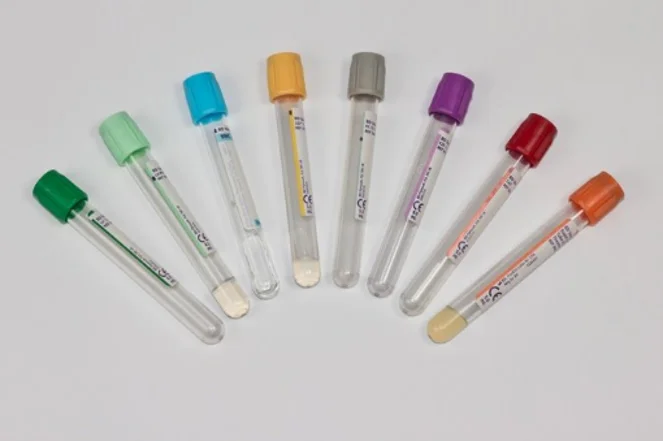
BD Vacutainer® blood collection tubes
A complex system of robotics, pneumatic and electrical systems, operate at an impressive rate. Each workstation is dedicated to a single step in the production process and is supported by a vision system that provides constant images of the product as it undergoes assembly. Thresholds are tightly set ensuring that any defect in the components, assembly or final product is identified in real time leading to rejection at the workstation.
This not only maintains the high quality of the product demanded by the intended use but also allows intervention to ensure further components and materials are not wasted. Real time electronic boards and onboard software inform the associate of the failure rates versus established targets helping to troubleshoot any mechanical issues and avoid further drift.
One thing that stood out was the cleanliness of the production site. All areas are clear of obstacles and any waste created in the production process is collected in controlled ways and removed regularly to avoid build up. A zonal system ensures that entry to production areas is restricted to trained operators, with further safety systems in place to avoid interruption to production or accidents.
Next, I was shown the packing and sterilisation area of this building where finished, boxed and labelled products are arranged into consignments by large robotic arms. One thing I did not realise is the sterilisation process is the final act. Boxes of completed product are irradiated on site by two cobalt irradiators. Following irradiation, the products are ready to ship to customers. These products, in effect, are already sold and allocated to customers.
Jason Richards completed this part of the tour and we de-gowned and washed up ready to move on.
Building Two
The second part of the tour was a visit to Building Two, hosted by Max Leach. Once through the PPE process I was taken into the main production area, more modern than Building One and significantly quieter.
A different range of products are assembled in this building, including the BD Vacutainer® Barricor™ Plasma Blood Collection tube along with its mechanical separator, BD Vacutainer® Push Button Blood Collection Set, BD Vacutainer® Eclipse™ Signal™ Blood Collection Needle and the BD Preset™ Eclipse™ Syringe and the BD A-Line™ Syringe, for blood gas sampling.
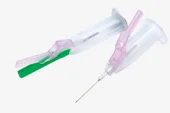
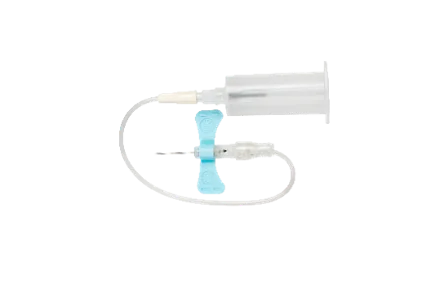
BD Vacutainer® Eclipse™ Signal™ Blood Collection Needle, BD Vacutainer® Push Button Blood Collection Set
These products require more assembly as they are made up of multiple components. The BD Vacutainer® Push Button Blood Collection Set has 19 components which are assembled in a defined order through a series of robotics and curing processes (for the solidification of adhesives). Once again, a vision system is employed which continuously images the product for any exceeding of set tolerances. Two of the rare issues were demonstrated whilst I was on the tour. The vision system had isolated one product for an adhesive problem where a minute amount had spread beyond the tolerance. The vision system also rejected a product for a misplaced needle which the naked eye would be unlikely to detect.
Although highly unlikely to have affected the use or performance of the product itself, the materials were ejected to waste and recorded by the informatics system. This underlines the company’s focus on excellence, quality and safety, as well as patient experience.
I noticed a series of communication boards along the internal perimeter of the building. Being inquisitive I asked Max to explain how they worked and what the impact is on productivity. The boards capture productivity information including production numbers versus target, as well as incidents such as breakdowns, production interruptions or issues encountered during a shift, through a range of graphs and tables. Associates record details of what has occurred, any known causes plus interventions, giving insight to other associates and management leads. Everything was very transparent.
The communication boards were accompanied by electronic interactive screens where data could be further drilled. It is not only important to understand which workstation has experienced production issues, but imperative to be able to interrogate data to uncover which micro-process needs addressing to restore full efficiency and productivity.
This is another factor that stood out for me. Through embedding Kaizen and LEAN processes, productivity, efficiency and quality can be maximised and most importantly, maintained. Continuity of supply is a basic expectation of product users, especially when the items produced at this site are heavily relied upon to deliver routine care to patients.
The site can increase or decrease production based on forecasting, with very little lead time required due to the site manufacturing the majority of the components needed to assemble the products. Without heavily relying on external suppliers Becton Dickinson has full control of production limits and targets. In times of crisis, such as the COVID pandemic, the company has been able to maintain supply through working closely with NHS partners. I know first-hand how hard employees worked to maintain production and supply whilst supporting national allocation initiatives. For this reason and many others, the company is truly proud of their team and the role they play in supporting healthcare.
My tour was supported by Mike Fitzpatrick on the BD Vacutainer® Eclipse™ Signal™ manufacturing line and Kevin Childs on the BD Preset™ Eclipse™ Syringe and the BD A-Line™ Syringe line. Both spoke expertly about the production of these products and the contribution they had made to streamlining their production. Kevin spoke enthusiastically about the project he led automating the processes in the production of the BD Preset™ Eclipse™ Syringe and the BD A-Line™ Syringe.
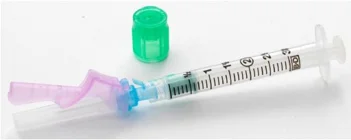
BD Preset™ Eclipse™ Syringe with safety needle
A standout moment in the tour of Building Two was observing the packing of the needle holders. This I would compare to an 8-foot tarantula erratically bouncing around a transparent walled room, attempting escape. Thin robotic arms moved at great speed, accurately dispensing the products into the correct orientation for sealing. This would be a time-consuming process without automation and not particularly rewarding for any individual.
Tour End
Throughout the tour, it was clear that employees have a voice within the company, and I was told of team building activities and social events the company and associates regularly support. Social values are certainly a priority for the company including recycling, sustainability and ethical sourcing.
As the tour ended there was an opportunity to speak with Paula Barbour who heads up the apprenticeship programme at the site. The programme had evolved and grown in recent years, working with local educational organisations to provide a 3-year training course and qualification with an annual intake, following a rigorous selection process, of 10-12 apprentices.
I was happy to hear that a high number of apprentices are recruited into substantive roles on completion of the apprenticeship, with some of the senior staff being examples of those who’ve stayed with the company for long term careers and development.
I’d like to thank the staff at Becton Dickinson’s Plymouth site for their hospitality and candour during my tour, and for taking time out of their busy schedules to accommodate me. Attending a site visit such as this can really shape your perspective on the wider factors involved in the delivery of patient care. Without high quality, effective and sustainable healthcare products patients would not receive the levels of care they deserve.
Thank you to Becton Dickinson for the opportunity to see behind the scenes.
Tony Cambridge
Independent Consultant, Diagnostics and Innovation
BD, the BD Logo and BD Vacutainer® are trademarks of Becton, Dickinson and Company.

Tony Cambridge is the Managing Director of Thornhill Healthcare Events and Consultancy, and former Lead Biomedical Scientist in the Pathology Management team of a busy acute care hospital in England. He frequently speaks at national and international healthcare events, and is a key opinion leader for point of care testing. He is also a member…

The company was set up in 2018 by Tony Cambridge MSc. BSc. Lead Biomedical Scientist, who is the managing director. With over 20 years experience in Blood Sciences and more recently Pathology management, Tony set out to provide affordable training opportunities to healthcare organisations through a number of different ways, from small group seminars to…