
POCTInnovators were invited to attend the i-STAT User Network meeting held in London. The programme included customers using or evaluating the i-STAT devices, each feeding back on their experiences, showcasing the utility and performance of this versatile diagnostic platform. The day was a great opportunity for sharing best practices and discussing innovation in point of care diagnostics.
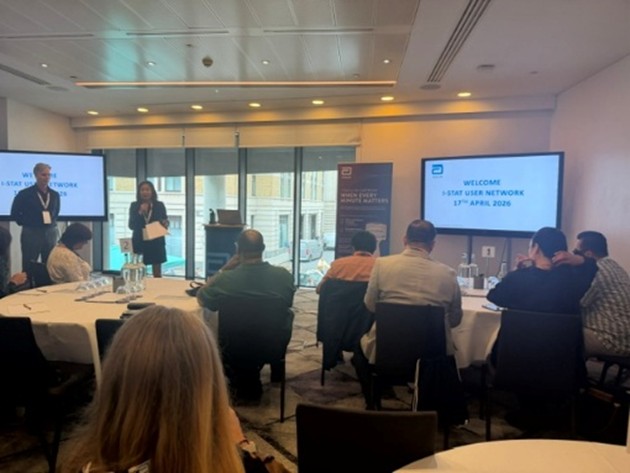
The first presentation was delivered by Rhiannon Marr, Oxford University Hospitals (OUH) POCT Manager, reporting on the evaluation work being carried out within the organisation. Specifically, the evaluation work focussed on hs-Troponin I using the i-STAT Alinity device. The data driven presentation gave a comprehensive overview of the method design and conclusions derived from their work comparing methods between the medical laboratory assays and point of care solutions.

The highly experienced OUH point of care team, who currently support the use of over 140 i-STAT devices across the organisation, were looking at the feasibility of incorporating hs-Troponin I testing into their emergency, and potentially, pre-hospital services. The team collaborated with their Emergency Department (ED) research team and Acute Admissions Unit (AAU) team members for this study. Samples were analysed for patients presenting in ED or referred to AAU with chest pain, with a routine sample also being sent to the laboratory as part of the existing pathway.
The study concluded that the i-STAT device is reliable and robust in the hands of trained operators.
With better CVs than the laboratory test, the i-STAT results were found to be reproducible, especially for an immunoassay method at the point of care. As a result, OUH’s ED will implement the i-STAT hs-Troponin I in June 2026.
Rhiannon’s presentation was followed by Haval Ozgun, General Manager at South West London Pathology (SWLP). His talk focused on the operational challenges of managing chest pain in acute and emergency settings, highlighting Kingston Hospital’s role as the first Emergency Department in the UK to adopt the i‑STAT high-sensitivity Troponin I test into routine clinical practice.
Haval began by outlining the challenges faced by emergency departments such as risk stratification, diagnostic uncertainty, time constraints, patient flow and length of stay in departments along with the current limitations of diagnostic tools and the potential for missed diagnosis.
Recognising that chest pain is one of the most common reasons for patients to present in the ED, the amount of resource dedicated to this health issue is considerable placing additional burden on the daily workload within these areas. Operational and quality targets, aimed at improving patient flow can lead to over-crowding or ‘mini-admissions’ where clinicians continue to wait for a laboratory result to become available to allow for safe interpretation and clinical decision. The challenge then becomes a balancing act between efficient use of resources and patient safety. Diagnostic tools that can support both factors could prove invaluable in the management of the patient and the department activities.
The team set about evaluating the use of hs-Troponin I in acute and emergency settings to enhance clinical decision making, providing early risk stratification and rule out of MI. As 85-90% of chest pain patients do not have MI, the adoption of this test in the pre-admission population is aimed at safe rule out and faster discharge. This in turn would support safe Same Day Emergency Care (SDEC) for patients who have had myocardial damage and require specialist treatment, potentially urgent referral to the cardiac cath labs.
Haval spoke about the impact on hospital efficiencies including capacity and flow, recognising Abbott’s contribution to supporting the evaluation through training and initial verification work.

Digital integration of the test and access to real time data is essential to establish the impact of the test, something invaluable when gaining clinical support and ongoing funding for testing and workforce. This also goes a long way in addressing any clinical concerns or scepticism.
Haval was clear that the introduction of the point of care test was accomplished through collaboration between the laboratory and clinical specialties. He used the word ‘synergy’ to describe the relationship between point of care and laboratory, leading to success in delivery of the project. The next steps include full connectivity with clinical systems so that the point of care service is fully integrated within the digital eco-system. The team hopes to bring the service within scope of UKAS accreditation next year. At the time of writing the work has been recognised by the IBMS and shortlisted as part of the IBMS innovation awards for 2026.
Future utility includes pre-hospital care such as implementing within the ambulance service and community (Urgent Treatment Centres, Community Diagnostics Centres) with potential for use in cardiac health such as screening and monitoring.
Haval stated that the i-STAT is an enabler due to its versatility, trusted performance and range of tests. One of the greatest impacts is on patients, reducing anxiety and improving satisfaction. The introduction of this test fully aligns with the objectives of the NHS 10-year plan; prevention and early detection; integrated care; improved same day emergency care and reduce hospital pressure; increased productivity; reduce health inequalities; digital transformation; and demonstrate financial sustainability.
Our next presentation came from Ceri Parfitt who covered quality assurance in POCT from a WEQAS perspective. Ceri covered a wide range of quality assurance processes, recognising the training and competency burden that comes with assuring the quality of results from so many devices across a point of care service.
The largest service is usually glucose meters, combined with ketone monitoring in most cases. The number of devices within a service can run into the hundreds which makes a full review of external quality assurance results a challenge for most service providers. Not only does the distribution of quality material take up a huge amount of time and resources, collating and reviewing the results, plus taking corrective action can also provide challenging.
A useful table was shared within the presentation illustrating the differences between internal quality control and external quality assurance. The table provided a go-to list of fundamental differences between these two quality processes from known concentrations with iQC to unknown with EQA. Frequency and what is being assessed was also covered and emphasis on a combined approach was very much the message. A well-designed quality assessment process can promote excellence but also identify non-conformance at the earliest opportunity so that corrective action can be taken. This assures the quality of the service and safe results for patient care.

The presentation moved onto the risk of getting it wrong and the clinical impact on patient care. Complex devices, tests and processes need additional consideration when designing the quality approach. By increasing iQC frequency you can avoid widespread recall of patient results when quality data indicates poor performance. This in turn improves faith in point of care testing and avoids unnecessary use of resources which should be directed elsewhere.
Ceri also referred to ensuring good quality of results when a patient is about to undergo a highly impactful medical procedure. Clinicians need to have faith in the results being produced by point of care devices as the results often guide clinical decisions before, during and after medical procedures.
In terms of selection of quality materials and EQA schemes, the speaker pointed out that technical and clinical ranges must be covered at appropriate concentrations, especially around clinical decision limits. Some materials have concentrations which overlap and have wide target ranges which can introduce risk whereby an incorrect material can be performed but a result obtained that falls within the overlapping range. Food for thought indeed.

The presentation moved onto the risk of getting it wrong and the clinical impact on patient care. Complex devices, tests and processes need additional consideration when designing the quality approach. By increasing iQC frequency you can avoid widespread recall of patient results when quality data indicates poor performance. This in turn improves faith in point of care testing and avoids unnecessary use of resources which should be directed elsewhere.
Ceri also referred to ensuring good quality of results when a patient is about to undergo a highly impactful medical procedure. Clinicians need to have faith in the results being produced by point of care devices as the results often guide clinical decisions before, during and after medical procedures.
In terms of selection of quality materials and EQA schemes, the speaker pointed out that technical and clinical ranges must be covered at appropriate concentrations, especially around clinical decision limits. Some materials have concentrations which overlap and have wide target ranges which can introduce risk whereby an incorrect material can be performed but a result obtained that falls within the overlapping range. Food for thought indeed.

The final messages within the presentation focussed on a standard EQA report and their interpretation, illustrating some of the pitfalls of reviewing quality data. In conclusion we were reminded of the important role that quality assurance plays in post market vigilance, escalation processes for poor performance from the user and EQA provider sides, and what support is available for troubleshooting.
Next steps included improved digital integration of EQA results reducing time and effort in collecting and reviewing results. We are heading towards real time monitoring of iQC and EQA results where poor performance can be identified as results are produced, backed up by dashboard technology that is illustrative and supports the end user.
After a short break the next speaker was Darren Browne, POCT Manager, Darent Valley Hospital, Dartford, Kent, with a presentation entitled ‘Centralised Point of Care Management: Best Practices Across Diverse Clinical Settings.’
Darren stated he is an advocate for the i-STAT and AegisPOC system and has implemented a connected and non-connected service. Paying particular attention to the restricted resources at his disposal, Darren pointed out that the middleware becomes an additional member of staff in terms of the benefits it adds and time saved across the team.
To illustrate the power that point of care has in supporting optimised patient care, an example from Radiology was offered whereby creatinine measurements are used to assess kidney function ahead of imaging with contrast. Without these measurements at the point of care, many scans would need to be postponed if a laboratory creatinine and eGFR measurement is not available to the clinical teams. The i-STAT system is capable of these tests and has become a valuable tool in the armoury of clinical teams.
A parting message for this part of the presentation was the impact POCT can have in supporting 7-day services and clinical targets such as the two week wait (2ww) for oncology referrals.
The talk turned more operational where Darren shared his experience of bidding for funding to develop services. Examples were given of different funding streams and the bidding processes which developed into a valuable discussion in the room after the talk finished, as part of an extensive Q&A session. This discussion covered capital and revenue funding streams, business case formulation and shared experiences from the attendees.
The session was wrapped up with the following message. We should all be focussed on the clinical impact of a test, rather than just installing devices and adopting tests for the sake of it. Clinical impact must be demonstrated at the funding stage so that true value can be realised.
Our next presenters, Bethan Phillips and Freya Willems from Berkshire and Surrey Pathology Services (BSPS), shared their experience of driving impact in pre-hospital care by innovating community care pathways. This is a hot topic with patient care undergoing a shift from hospital to community as part of the NHS 10-year health plan.
Our speakers offered an overview of the extensive services covered by the BSPS community team which has been heavily invested in, including work undertaken with primary care networks, community diagnostic centres, hospital at home teams and virtual wards. BSPS have moved to create two distinct point of care teams. One team covers hospital services whilst the other covers those services in the community. Each team has a clinical and operational lead and there is no cross over between the teams in terms of daily activities and responsibilities. Of course, together they form a formidable multi-disciplinary team, working to the same quality management system.
Bethan and Freya described how the team perform site visits across commissioning groups, engaging with end users and adopters to understand the issues they face and how services can be tailored to meet these needs. Communication and collaboration are themes in many of the presentations at this user group meeting.
Something that grounds us and the work we do across point of care is hearing about patient stories and experiences. The versatility of the i-STAT system allows for a number of applications across the healthcare landscape, allowing treatment at home, admission avoidance and improved patient experience and outcomes. In summary, the team recognised the increasing diversity of services required in the community. Keeping patients at home and avoiding unnecessary admission to hospital supports a more effective healthcare ecosystem, reducing stress and anxiety in patients and their families. Some patients may require re-hospitalisation and point of care testing in the home or the community can safely assess whether this is required without placing additional burden on emergency services such as ambulances and first responders.
The same high quality of service is provided by the community teams through a flexible and adaptable approach, pushing standards within these neighbourhood healthcare models, backed up by an effective business model where impact can be directly related to the resources directed towards the community.
The final session of the day is interactive and focussed on the Abbott informatics system AegisPOC and how the platform supports Abbott Point of Care and third-party products to optimise care.
Through successful integration with the point of care service, AegisPOC streamlines the bi-directional flow of results across hospital and community services using a range of innovative features. Through implementing this digital solution users can expect to see improvements in rapid results with streamlined data handling. In turn, centralised control can lead to reduced cost and operational efficiencies that release resources.
One of the major concerns for healthcare providers is cyber security and AegisPOC, through one platform, offers the assurances required to keep patient and operational data secure. From a quality perspective, the functionality within the platform allows for services to be audit-ready with transparent processes and insightful data presentation.
AegisPOC can integrate with major laboratory and hospital information systems (EPIC, CERNER, McKesson, SUNQUEST etc.), can be implemented rapidly and offers flexibility based on the customer needs and budget. Service providers insist on exceptional quality and compliance management. Through interactive dashboards and innovative quality features such as configurable manual result entry, Levey-Jennings plots, corrective action and delta charts, AegisPOC can meet these demands and be configured to reflect what is important to the service provider.

The platform offers the standard user and device controls allowing teams to manage performance and ensure competency through granted access and re-certification. The day-to-day operational tasks are also addressed such as inventory management and quality control review. Users can be locked out of the system and reinstated once any training issues have been addressed. The i-STAT family provides a wide range of tests and panels across the varied cartridge range, all easily tracked and managed through AegisPOC.
The session was interactive and invited the attendees to discuss the utility of the informatics system, including examples of where customers already gain from the wide functionality AegisPOC offers in managing point of care activities across the healthcare landscape. The user group was brought to a close by the Abbott team, thanking the attendees for their contribution to such a successful day.

POCTInnovators would like to thank Abbott Point of Care team for inviting us to attend the user group meeting and allowing us to experience the event and discussions that were provoked by the exceptional content. Congratulations to the speakers for making this a very valuable day, and to Abbott, a full partner of POCTInnovators, for organising this user meeting for their customers.

Tony Cambridge is the Managing Director of Thornhill Healthcare Events and Consultancy, and former Lead Biomedical Scientist in the Pathology Management team of a busy acute care hospital in England. He frequently speaks at national and international healthcare events, and is a key opinion leader for point of care testing. He is also a member…

Abbott Point of Care is a division of Abbott, a global, diversified health care innovator with a legacy of pioneering work in medical diagnostics and devices. We put our whole global force behind solutions that empower medical and economic decision-makers to improve health care and people’s lives. As the manufacturer of the i-STAT System, we…